

Coach Graneto presents a set of heavy hedging on ball screens:
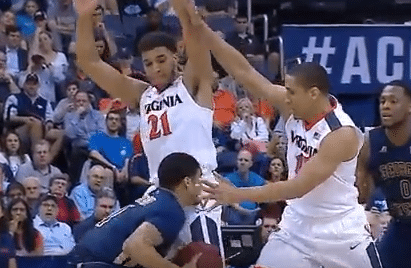
Heavy Hedging on ball screens is something that I thoroughly believe in. This form of defending an on ball screens is used by Tony Bennett (Head coach at University of Virginia; formerly head coach at Washington State), Ben Howland (Head Coach at UCLA), and countless others throughout college and high school basketball. This form of defending an on ball screen requires big men who can move their feet and recover quickly, tough players who can get over the top of an on ball screen, and smart players who understand rotations while in help side. Here are the Keys to heavy hedging an on ball screen:
- Communication: Like all things on defense communication is vitally important. The player who is guarding the screener must communicate that a screen is coming, the player who is getting over the top of the on ball screen must communicate when he is back with the player with the ball, and the players in help side must communicate where rotations are going to occur.
- We Must Force the Player with the Ball to Go Off the On Ball Screen: It is the job of the player who is guarding the ball to force the player to go off of the on ball screen. This is important because that is where are help is at. If the offensive player denies the on ball screen and goes around us we are in trouble. Once this is accomplished our playing guarding the ball goes OVER THE TOP OF THE SCREEN. Never under.
- The “Heavy Hedge”: The “Heavy Hedge” requires the player guarding the screener to force the player going off of the screen to take two or three dribbles backwards, or sideways (without being split), while moving laterally with the player. This allows time for the player getting through the screen to recover. After this is accomplished and the player guarding the ball is through the screen then the hedger must SPRINT back into the play and look to recover to the screener. If this is not possible, then he simply rotates to the next player.
- Understanding Rotations (Diagrams show different scenarios and rotations): Players must be able to understand where their next rotation is coming, and read if they need to rotate. We want our hedger to get back to the man he is guarding so that we do not have a mismatch on the block, but if this is not possible we need to be able to rotate to the next available guy. Because the hedger is so far away from the basket help side defenders must SPRINT and COMMUNICATE to their next rotation allowing time for the hedger to get back into the play.
* Heavy hedging on ball screens is something that I would advise for a team that has posts who can move laterally. I would look into “icing” on ball screens if you have big men who cannot get out and hedge an on ball screen effectively.
 Jordan Graneto is an Assistant Varsity Basketball Coach at Sprague High School. You can follow him on Twitter! @jordangraneto.

0 Comments